Tiny Monkeys, Huge Crowd

Liam Reilly
| 10-06-2026
 · Animal Team
Good day, Friends! Imagine walking through a dense rainforest and hearing high-pitched chirps echoing through the canopy. Suddenly, dozens of tiny monkeys race between the branches like flashes of gold and black.
This is the everyday world of squirrel monkeys, among the most social primates in the Americas. While many monkey species live in small family groups, squirrel monkeys can gather in massive troops of more than 500 individuals.
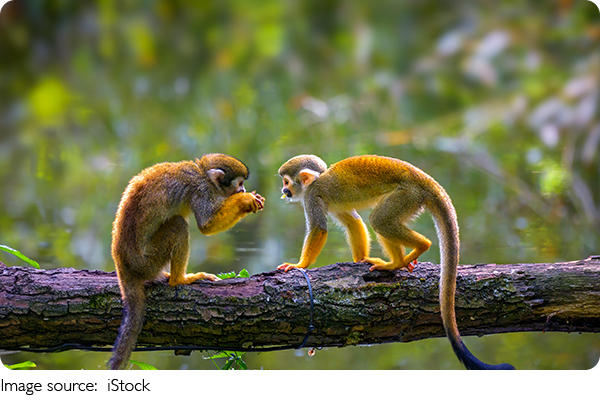
Why Do Squirrel Monkeys Gather in Such Huge Numbers?
Squirrel monkeys inhabit the tropical forests of Central and South America, particularly in countries such as Brazil, Peru, Colombia, and Bolivia. They spend most of their lives high in the forest canopy, where food resources constantly change with the seasons.
Fluffy on the outside, but what hides behind that grin? You won't expect this!
Why spend all day digging little holes? The answer is wilder than you think!
A giant neck wasn't an accident! Here's what shaped it.
Massive horns, expert climbing skills, and survival in extreme mountain environments
Tiny jungle acrobats or secret masterminds? The answer may surprise you!
Rare genes or hidden risk? The truth may surprise you!
Living in a massive troop offers a major survival advantage. Birds of prey, large snakes, wild cats, and even some monkeys can prey on young squirrel monkeys. In a group of hundreds, many eyes are constantly watching for danger.
Researchers have observed that when one monkey spots a predator, it gives a sharp alarm call, causing the entire troop to react within seconds. This "many eyes effect" greatly reduces the chance that any single individual will become a target. The larger the group, the more efficient the warning system becomes.
A Flexible Society, Not One Giant Family
Although troops may contain several hundred monkeys, they do not travel as one tightly packed unit all day. Instead, they often split into smaller foraging parties before reuniting later. Primatologists refer to this behavior as a fission-fusion social structure. These smaller subgroups help reduce competition for food. Squirrel monkeys mainly feed on insects, spiders, fruits, flowers, and small vertebrates.
Insects, especially grasshoppers and caterpillars, are a crucial protein source and are often scattered throughout the forest. Dividing into smaller teams allows more animals to feed efficiently without exhausting local resources. Unlike some primates that establish strict territories, squirrel monkey troops frequently overlap with neighboring groups. Encounters are usually noisy but rarely escalate into serious fights.
Communication in a Crowd
Maintaining contact among hundreds of fast-moving monkeys requires an impressive communication system. Squirrel monkeys use a combination of vocal calls, face expressions, body postures, and scent signals. Scientists have documented more than two dozen distinct vocalizations, each serving a different purpose.
Soft chirps help individuals stay connected while moving through dense foliage, while louder calls warn of predators or signal excitement when food is found. Interestingly, scent also plays an important role. Mature males often rub secretions from specialized glands onto their bodies and nearby branches.
During the breeding season, these scents may provide information about reproductive condition and social status. For a troop spread across several acres of forest, this mix of sounds and smells functions like a sophisticated communication network.
The Curious World of Massive Males
One of the most unusual features of squirrel monkey society appears during the breeding season. Fully grown males experience a temporary physical transformation that makes their shoulders, chest, and upper body appear much larger than usual.
Although this change gives them a heavier and more muscular appearance, it is not caused by the buildup of body tissue used for energy storage. Instead, the increase in size is mainly linked to water retention and hormonal changes that occur during the reproductive period.
Hormonal changes cause water retention and increased muscle volume around the shoulders, chest, and upper body, making them appear significantly bigger. Some males can increase their body mass by nearly 20 percent over a short period. Biologists believe this larger appearance helps them compete for mates without requiring constant physical combat.
Larger-looking individuals may gain an advantage simply through visual intimidation. Once the breeding season ends, these males gradually return to their normal size.
Raising the Next Generation
Female squirrel monkeys usually give birth to a single infant after a pregnancy lasting around five months. Newborns cling tightly to their mother's back as she moves through the trees, often making remarkable leaps between branches.
Unlike species that rely heavily on cooperative childcare, squirrel monkey mothers handle most parental duties themselves. However, the large troop still provides indirect protection. With so many adults nearby, predators have fewer opportunities to approach unnoticed.
Young monkeys spend their first months observing older troop members. Through play and exploration, they learn how to locate insects, identify edible fruits, and recognize alarm calls. These social lessons are essential for survival in the complex rainforest environment.
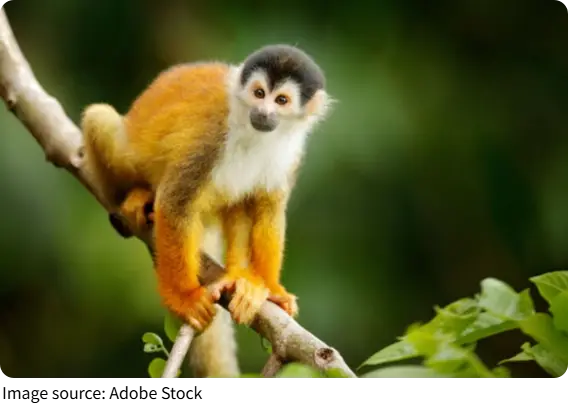
The enormous troop size of squirrel monkeys is not simply a random behavior—it is an evolutionary solution to the challenges of life in tropical forests. Constant predator pressure, scattered food supplies, and the need for rapid communication have shaped a society where cooperation offers clear advantages.